I guess I never realized how attached I was to my computer until the hard drive crashed (I think) this morning. Yesterday was something of a whirlwind - between sharing my musings about Web 2.0 groups with interested Fellows, to clarifying what I can do to make my Keep On Learning site a via "publishable" piece, to canoeing down (and eventually swimming in) the mighty Housatonic River I was exhausted. We have spotty Internet connection here at best, so I captured by blogs thoughts in Word late last night and go up early to post.
Alas - the computer does nothing.
Thanks to JoAnn, I am working on a computer but it isn't mine, with my scattered desktop and the comforting pictures of my family in the background. I am trying to remain calm -but the flood of work that I have created may be lost and it is causing rising panic. (I know - I should back up more often and I have learned a powerful lesson!!) Fortunately - a great deal of my work is available to me on-line through blogs and wikis so I am not totally despondent.
I have come to realize that my computer has become an extension of my hands. Pens and pencils work at times, but how I organize my thoughts and my writing is all done electronically. It is comforting to me - the warmth of the battery, the click of they keys, the glow of the screen. I am not sure how to write and organize without it.
Much of our conversation the past two days has been around the use of electronic tools - and I can see the look of confusion and trepidation on the faces of many of my Fellows. It can be a powerful way to join our two communities (Upstate and Downstate) into the one community we become in the summer - but it could also cause others to disengage. I am mindful of this as I ponder ways to integrate these tools into the Collegial Circle that I am planning for the Fall around literacy. I will need to take it slow, temper my enthusiasm to allow others to discover these tools the way that I have, ,and build the community of learners one at a time.
Cross-posted on Writing Frameworks.

A Vision for the Future
Our morning plenary session today focused on refining our vision. Visioning can at times be dull or perhaps seem too "touchy feely" to be worth the time spent developing it. But the activities we did today were powerful and thought provoking. More importantly - the activities helped us to refine our visions.
This was important for me, as clarity has been something of an issue for me of late. I think I know what I want to say - carefully select the best words to convey that meaning - but somehow when they come out, they come out in gibberish. Or at least it seems from the stunned look of the person of I am talking to. You know the look - somewhere between pity and confusion, when they start responding to you by speaking s-l-o-w-e-r and LOUDER?
Back to my vision! While I ponder how close my vision is to that of my organization - I have come to understand that it is about building capacity and efficacy. Because I have felt that I have been unsuccessful in using Web 2.0 tools in the past year to help build a sense of community, I took a step backward and thought about why that might be. I think there are three reasons why I was unsuccessful.
First, the technology. I was speaking with a colleague yesterday who I view as quite the risk-taker and we were discussing the use of blogs. She said it was one thing that she would never do because when it came to things on the computer - she just wasn't as comfortable as in the other areas in which I have seen her step out of her comfort zone. I thought about the comment for a while and realized that it holds true for many people. Some are afraid they might break something on the computer - others are afraid that they'll put something out there, accidentally and before it is polished, and then they can never take it back. This tells me that I need to focus on the use of the tools, but also on the culture of the schools I work with around what publishing on the web might mean.
Second, the time issue. This issue seems ever present and I am not sure how to address it. What I do know is I need to focus on how the tools can be integrated into classroom practice, or show what they might replace, before the time dragon is quieted.
The last issue is a bit tricky. In reflecting on conversations with folks and on blog posts, it seems that as teachers we don't often feel comfortable with our own writing. It isn't something that we are asked to do regularly and for some, it seems to be a chore. Yet - we want our students to do it on a much more regular basis. I am thinking about asking teachers to set up their own blogs first - to experiment with their writing, find their voice, and be comfortable becoming a writer. Then - as their comfort level with both the tool and the writing increases, they might be able to see a use in their classroom. And hopefully, might become active participants in the blogging community.
This was important for me, as clarity has been something of an issue for me of late. I think I know what I want to say - carefully select the best words to convey that meaning - but somehow when they come out, they come out in gibberish. Or at least it seems from the stunned look of the person of I am talking to. You know the look - somewhere between pity and confusion, when they start responding to you by speaking s-l-o-w-e-r and LOUDER?
Back to my vision! While I ponder how close my vision is to that of my organization - I have come to understand that it is about building capacity and efficacy. Because I have felt that I have been unsuccessful in using Web 2.0 tools in the past year to help build a sense of community, I took a step backward and thought about why that might be. I think there are three reasons why I was unsuccessful.
First, the technology. I was speaking with a colleague yesterday who I view as quite the risk-taker and we were discussing the use of blogs. She said it was one thing that she would never do because when it came to things on the computer - she just wasn't as comfortable as in the other areas in which I have seen her step out of her comfort zone. I thought about the comment for a while and realized that it holds true for many people. Some are afraid they might break something on the computer - others are afraid that they'll put something out there, accidentally and before it is polished, and then they can never take it back. This tells me that I need to focus on the use of the tools, but also on the culture of the schools I work with around what publishing on the web might mean.
Second, the time issue. This issue seems ever present and I am not sure how to address it. What I do know is I need to focus on how the tools can be integrated into classroom practice, or show what they might replace, before the time dragon is quieted.
The last issue is a bit tricky. In reflecting on conversations with folks and on blog posts, it seems that as teachers we don't often feel comfortable with our own writing. It isn't something that we are asked to do regularly and for some, it seems to be a chore. Yet - we want our students to do it on a much more regular basis. I am thinking about asking teachers to set up their own blogs first - to experiment with their writing, find their voice, and be comfortable becoming a writer. Then - as their comfort level with both the tool and the writing increases, they might be able to see a use in their classroom. And hopefully, might become active participants in the blogging community.
More Questions than Answers
This blog was birthed from an idea Jenn had while we were at a CSETL meeting. We both belong to this professional learning community and were looking for ways to replicate that feeling with other folks in our region who held similar positions. Although we created this blog almost one year ago - we haven’t exactly been successful in creating a community using these tools.
One thing I am investigating at our summer retreat this week is the roll that wikis and blogs can play in creating a learning community. I have read everything I can get my hands on (not too terribly much to be honest) but most importantly, I have experimented this past year with creating the community using these tools. There have been some roadblocks – some I expected and others I did not – that my fellow Fellows are helping me grapple with, as well as sharing with me this first week.
Nearing the end of our first day, some things keep bubbling to the surface:
1. There is a great deal of literature out about what it takes to build learning communities. Is it really possible to build these communities using technology tools? I believe that it is possible, but it will involve a shift for teachers and quite a bit of “unknown,” particularly in the use of the technology tools. I really like the model that Stanford University has developed in order to move through the phases of wiki use to build a community of practice. I think that using this framework, I am going to see if I can adapt it to blogging and then reflect a bit on where I have been the past year in the use of these two tools to see what steps I may have skipped that might have been critical to move forward.

Image from Using Wikis to Build Learning Communities, Stanford Center for Innovations in Learning.
2. One reason that I value the use of blogs and wikis for classrooms of the future are that they create an authenticity for writing that has been absent lately in our "test centered" world. When using Web 2.0 tools, you are published – and published for the whole world to see. But I was reminded today that while I might in fact be “published,” my work has not been “peer reviewed.” Hasn’t it? Don’t blogs provide an opportunity for feedback and exchange of ideas? Whether my peers read my work or not certainly speaks to whether it fits their criteria for “good reading.” Many of the teachers I know who use blogs are working on the fact that the work must be in final format – proper spelling and grammar, solid foundation for the ideas presented. Some even have their students' work reviewed to create a "Hall of Fame." All information about good blogs talks about “citing” your sources, particularly if you are citing a fellow blogger. Aren’t those some of the hallmarks of a “peer reviewed” piece of writing? If not – what are we missing and what could we put into place to “legitimize” blog writing?
3. Time continues to crop up as I discuss the use of these tools with others. We all have very crazy and hectic schedules – deadlines to meet, balancing family and work obligations. So how do we fit these pieces in? When I first ventured into the Web 2.0 world, I had the same concerns. I set aside specific times to read and to write blogs, but even then I have fallen off the wagon. In order to fit it in – I needed to take something out. The piece I have removed is the purchasing of a physical newspaper – I no longer receive our local daily. Instead, I have formatted my RSS feed to be my ideal newspaper. I have sports (hockey and football only!), I have the education section (missing from most newspapers) and politics, as well as local news. The time I used to take to read a paper version, I now spend reading on-line and from a much richer variety of sources. I know this is not for everyone – but it is one solution!! Another piece that I am committed to doing this year is to track how long it takes me to read/write blogs (I am currently at 3 minutes on this piece – it will probably be a bit closer to 7 minutes by the time I proof-read and add links.) Hopefully – this will allow me to share with others my process and the amount of time it actually takes to participate in this manner.
My head is spinning but I am putting this out on blog form in order to get pushed back. I am hoping my fellow Fellows will take a break from their work this week to pop into my world and ask me questions, respond to my thoughts, and push my thinking – as they always do in person, but this time virtually, so that I can explore new perspectives and find other paths to follow.
P.S. I was wrong - I spent closer to 20 minutes completing this post as you see it now!
One thing I am investigating at our summer retreat this week is the roll that wikis and blogs can play in creating a learning community. I have read everything I can get my hands on (not too terribly much to be honest) but most importantly, I have experimented this past year with creating the community using these tools. There have been some roadblocks – some I expected and others I did not – that my fellow Fellows are helping me grapple with, as well as sharing with me this first week.
Nearing the end of our first day, some things keep bubbling to the surface:
1. There is a great deal of literature out about what it takes to build learning communities. Is it really possible to build these communities using technology tools? I believe that it is possible, but it will involve a shift for teachers and quite a bit of “unknown,” particularly in the use of the technology tools. I really like the model that Stanford University has developed in order to move through the phases of wiki use to build a community of practice. I think that using this framework, I am going to see if I can adapt it to blogging and then reflect a bit on where I have been the past year in the use of these two tools to see what steps I may have skipped that might have been critical to move forward.

Image from Using Wikis to Build Learning Communities, Stanford Center for Innovations in Learning.
2. One reason that I value the use of blogs and wikis for classrooms of the future are that they create an authenticity for writing that has been absent lately in our "test centered" world. When using Web 2.0 tools, you are published – and published for the whole world to see. But I was reminded today that while I might in fact be “published,” my work has not been “peer reviewed.” Hasn’t it? Don’t blogs provide an opportunity for feedback and exchange of ideas? Whether my peers read my work or not certainly speaks to whether it fits their criteria for “good reading.” Many of the teachers I know who use blogs are working on the fact that the work must be in final format – proper spelling and grammar, solid foundation for the ideas presented. Some even have their students' work reviewed to create a "Hall of Fame." All information about good blogs talks about “citing” your sources, particularly if you are citing a fellow blogger. Aren’t those some of the hallmarks of a “peer reviewed” piece of writing? If not – what are we missing and what could we put into place to “legitimize” blog writing?
3. Time continues to crop up as I discuss the use of these tools with others. We all have very crazy and hectic schedules – deadlines to meet, balancing family and work obligations. So how do we fit these pieces in? When I first ventured into the Web 2.0 world, I had the same concerns. I set aside specific times to read and to write blogs, but even then I have fallen off the wagon. In order to fit it in – I needed to take something out. The piece I have removed is the purchasing of a physical newspaper – I no longer receive our local daily. Instead, I have formatted my RSS feed to be my ideal newspaper. I have sports (hockey and football only!), I have the education section (missing from most newspapers) and politics, as well as local news. The time I used to take to read a paper version, I now spend reading on-line and from a much richer variety of sources. I know this is not for everyone – but it is one solution!! Another piece that I am committed to doing this year is to track how long it takes me to read/write blogs (I am currently at 3 minutes on this piece – it will probably be a bit closer to 7 minutes by the time I proof-read and add links.) Hopefully – this will allow me to share with others my process and the amount of time it actually takes to participate in this manner.
My head is spinning but I am putting this out on blog form in order to get pushed back. I am hoping my fellow Fellows will take a break from their work this week to pop into my world and ask me questions, respond to my thoughts, and push my thinking – as they always do in person, but this time virtually, so that I can explore new perspectives and find other paths to follow.
P.S. I was wrong - I spent closer to 20 minutes completing this post as you see it now!
Teaching the Academic Essentials - The Finale
I took a day off from blogging on the conference to let it all sink in. Honestly - the last day of the conference was the best for - with rapid fire connections happening all over the place.
Highlights:
1. When discussing the reading process, we often speak about before-during-after reading activities. But more importantly - as teachers we need to think about what we should be doing before we give the reading, while the reading is happening, and after the reading is completed. Seems like common-sense but the planning page provided here, along with the matrix discussed in a previous post, really tied things together for me. We discussed our purpose for having students read certain text, thinking about how we wanted them to interact with the text and how to monitor those strategies, and WHY we had them do particular things after the reading.
2. We need multiple entry points to reading. Again - common sense but the visual that was presented was pretty powerful!! (I'll see if I can scan my notes!) Kids have lots of barriers to reading: lack of background knowledge, social/emotional/cultural issues, vocabulary, poverty to name a few. We need to be purposeful in structuring our before-reading activities to help all students access the text.
3. Thinking in three complicates things. Never really thought about this before - but as we progressed through examples, it really started to make sense. For example, we could take the current war in Iraq. If we made a simple T-chart of the perspectives of those in the U.S. for and against the war, our students might do this easily. It also forces them into an "either or" position - where they have to decide which camp they fall into. That could be dangerous - and narrow. So - let's add the perspective of the Iraqi people. That could complicate matters. Now let's add the perspectives of the various Iraqi people - Sunni and Shia. Now - let's add the perspectives of Great Britain. See how things become much more complicated and will involve a higher level of thinking? The more layers we add - the more complex the thoughts.
Jim Burke also had an afternoon keynote - which will be podcast soon. Some highlights:
4. Learning should be an "invitation to struggle." In his work on academic essentials, Burke keeps coming up with words like "grapple" and "struggle" and "wrestle" - and those need not be bad things. Back to the weight-lifting analogy, education is something we are all trying to get better at - so wrestling with these things means we are growing.
5. First and foremost, Jim Burke is a teacher and one who obviously cares deeply about his students and their success. Over time, he and the class have developed a set of principles that are practiced in the classroom, and eventually in life. Telling a series of personal stories, Jim shared the following with us.
Cross-posted on Writing Frameworks.
Highlights:
1. When discussing the reading process, we often speak about before-during-after reading activities. But more importantly - as teachers we need to think about what we should be doing before we give the reading, while the reading is happening, and after the reading is completed. Seems like common-sense but the planning page provided here, along with the matrix discussed in a previous post, really tied things together for me. We discussed our purpose for having students read certain text, thinking about how we wanted them to interact with the text and how to monitor those strategies, and WHY we had them do particular things after the reading.
2. We need multiple entry points to reading. Again - common sense but the visual that was presented was pretty powerful!! (I'll see if I can scan my notes!) Kids have lots of barriers to reading: lack of background knowledge, social/emotional/cultural issues, vocabulary, poverty to name a few. We need to be purposeful in structuring our before-reading activities to help all students access the text.
3. Thinking in three complicates things. Never really thought about this before - but as we progressed through examples, it really started to make sense. For example, we could take the current war in Iraq. If we made a simple T-chart of the perspectives of those in the U.S. for and against the war, our students might do this easily. It also forces them into an "either or" position - where they have to decide which camp they fall into. That could be dangerous - and narrow. So - let's add the perspective of the Iraqi people. That could complicate matters. Now let's add the perspectives of the various Iraqi people - Sunni and Shia. Now - let's add the perspectives of Great Britain. See how things become much more complicated and will involve a higher level of thinking? The more layers we add - the more complex the thoughts.
Jim Burke also had an afternoon keynote - which will be podcast soon. Some highlights:
4. Learning should be an "invitation to struggle." In his work on academic essentials, Burke keeps coming up with words like "grapple" and "struggle" and "wrestle" - and those need not be bad things. Back to the weight-lifting analogy, education is something we are all trying to get better at - so wrestling with these things means we are growing.
5. First and foremost, Jim Burke is a teacher and one who obviously cares deeply about his students and their success. Over time, he and the class have developed a set of principles that are practiced in the classroom, and eventually in life. Telling a series of personal stories, Jim shared the following with us.
Put yourself out there!
Do what you think you can't.
Success is never an accident.
Everyone must find their "thing;" all education is SELF education.
You are worth the effort.
Invest in yourself.
If you cannot SEE it, you cannot BE it.
Cross-posted on Writing Frameworks.
Leadership that Works
It's always nice when someone does your work for you. . .
Read a review of: Marzano, Robert J.; McNulty, Brian A. & Waters, Timothy. (2005) School Leadership that Works: From Research to Results. Alexandra, VA: Association for Supervision and Curriculum Development.
Apparently, it's a must read. "This text absolutely belongs in a course that focuses on the principles of educational leadership."
Read a review of: Marzano, Robert J.; McNulty, Brian A. & Waters, Timothy. (2005) School Leadership that Works: From Research to Results. Alexandra, VA: Association for Supervision and Curriculum Development.
Apparently, it's a must read. "This text absolutely belongs in a course that focuses on the principles of educational leadership."
Teaching the Academic Essentials - Part 2
Top 5 take-aways from today:
1. "Discussion improves comprehension, increases engagement and enhances memory when it is structured, purposeful, meaningful, and constrained by time. Even one minute of effective classroom discussion shows measureable benefits to student learning." This was a nice reinforcement of what a CSETL Fellow has been sharing in her work with academic discourse, as well as a reinforcement of my belief that learning is social. While much of my learning during this workshop has come from the presenter, I have learned a great deal from those folks sitting around me, in part because the presenter has worked discussion into our day on a regular basis. It is a refreshing change from rushing through material. If I feel that way - I can only imagine what it will do for kids.
2. "You have the men you have - and it's up to you to make them into the soldiers you want them to be." This quote (or something like it!) was attributed to George Washington but it makes a great deal of sense about education as well. Whenever I hear teachers complaining that students don't work hard enough or won't do this and can't do that, I get a little angry. We should be teaching with the belief that the students in our classroom can succeed - or we have failed. I have always said that parents send us everything they've got - they aren't hiding the good ones/the smart ones at home! It is our job to teach each and every child that we are gifted with.
3. Most teachers, particularly those at the secondary level, don't know what we do when we "read" - it just happens to us. We, as teachers, need to be more explicit and transparent with our students and bring our process into the class. We did a great activity in the session today after reading a "complex" piece to chart visually our reading process - what we did when we didn't understand things, how we made connections to comprehend. This reflection was very helpful to me in thinking about how I have taught reading in the past - but also how I might be able to do it with teaching writing as well. I need to ponder this a bit - but you can bet there will be more to come!!
4. There are many different kinds of text and we use different strategies when we read them. I have known this - as I believe that each content area has it's own literacy. We read different things in social studies class then in science, math, and ELA. I needed to teach my kids how to "read" political cartoons, maps, newspaper articles written in the 1800s. Charting out what I do for each of these different texts will help me when I work with teacher and primary sources.
5. I don't like Yeats. I'm kidding - sort of! We did a great activity at the end of the session using "The Second Coming." The discussion around the poem and the strategies that we used were invigorating and inspiring. If I could open a school with the people sitting in that room today - the kids would be engaged and all see success. I am still tortured by the poem and what it means and the fact that I didn't get it the first three times we read it (not sure I still get it but I've read enough Internet reviews to fake it!!) Jim Burke made a great analogy today when we compared learning/reading to weight lifting. When you lift weights - you want to lift a weight heavy enough to cause fatigue. That allows your muscles to grow. If we don't challenge kids with difficult text - and teach them to navigate problems - they won't grow as readers. I might not like Yeats but I loved the discussion today!!
Cross posted on Writing Frameworks.
1. "Discussion improves comprehension, increases engagement and enhances memory when it is structured, purposeful, meaningful, and constrained by time. Even one minute of effective classroom discussion shows measureable benefits to student learning." This was a nice reinforcement of what a CSETL Fellow has been sharing in her work with academic discourse, as well as a reinforcement of my belief that learning is social. While much of my learning during this workshop has come from the presenter, I have learned a great deal from those folks sitting around me, in part because the presenter has worked discussion into our day on a regular basis. It is a refreshing change from rushing through material. If I feel that way - I can only imagine what it will do for kids.
2. "You have the men you have - and it's up to you to make them into the soldiers you want them to be." This quote (or something like it!) was attributed to George Washington but it makes a great deal of sense about education as well. Whenever I hear teachers complaining that students don't work hard enough or won't do this and can't do that, I get a little angry. We should be teaching with the belief that the students in our classroom can succeed - or we have failed. I have always said that parents send us everything they've got - they aren't hiding the good ones/the smart ones at home! It is our job to teach each and every child that we are gifted with.
3. Most teachers, particularly those at the secondary level, don't know what we do when we "read" - it just happens to us. We, as teachers, need to be more explicit and transparent with our students and bring our process into the class. We did a great activity in the session today after reading a "complex" piece to chart visually our reading process - what we did when we didn't understand things, how we made connections to comprehend. This reflection was very helpful to me in thinking about how I have taught reading in the past - but also how I might be able to do it with teaching writing as well. I need to ponder this a bit - but you can bet there will be more to come!!
4. There are many different kinds of text and we use different strategies when we read them. I have known this - as I believe that each content area has it's own literacy. We read different things in social studies class then in science, math, and ELA. I needed to teach my kids how to "read" political cartoons, maps, newspaper articles written in the 1800s. Charting out what I do for each of these different texts will help me when I work with teacher and primary sources.
5. I don't like Yeats. I'm kidding - sort of! We did a great activity at the end of the session using "The Second Coming." The discussion around the poem and the strategies that we used were invigorating and inspiring. If I could open a school with the people sitting in that room today - the kids would be engaged and all see success. I am still tortured by the poem and what it means and the fact that I didn't get it the first three times we read it (not sure I still get it but I've read enough Internet reviews to fake it!!) Jim Burke made a great analogy today when we compared learning/reading to weight lifting. When you lift weights - you want to lift a weight heavy enough to cause fatigue. That allows your muscles to grow. If we don't challenge kids with difficult text - and teach them to navigate problems - they won't grow as readers. I might not like Yeats but I loved the discussion today!!
Cross posted on Writing Frameworks.
Teaching the Academic Essentials - Part 1
I'm lucky enough to be spending the next three days re-charging by attending the 3rd Annual Reading Institute in Jamestown, N.Y. First - I need to say kudos to the folks who have organized this - it is impressive!! And an even louder round of applause for the over 200 teachers who are attending this session in the "shadow" of their school year (we just ended last Friday!)
The speaker that I was originally going to be spending time with had a family emergency and so I was cast adrift. Fortunately - my dear friend David charted a course for me. So I will spend the rest of the week with Jim Burke.
I hope this doesn't offend him but to this point, he has presented in much the same way that I do. If we are going to be spending time writing - we best be writing!! Too often - we want to sit and absorb information. If our brains click with it - we use it. If they don't - we discard it. But if we really engage in the activities, then we can determine how to make it our own, to make it work inside our own classrooms. I can understand how my participants feel when I make them do this - so I took some notes about what I can tweak in my own work - but I loved that I got to write, write, write today!!
Top Five from the session today:
1. "Graphic organizer" can be too limiting a term. Instead - we should be providing students with "tools for thought." I liked this idea - it was really about setting up a simple tool for students to organize thoughts and some guiding questions/prompts to start them on their way. We folded a piece of paper into thirds and simply labeled them to guide our reflections. Jim then led us in narrowing down what we had written about to reflect further - and then share with colleagues. For this exercise, we reflected upon what worked this year (or what didn't!)
2. Weekly poems. This was something that worked for Jim last year (yes, Virgina - even presenters share!!) He selected short poems (less than 30 lines) that students read each day for a week. Each time they read the poem - they reflected or reacted to something different (initial reactions, imagery, tone, etc.) so that at the end of the week, they had notes to use to write an analytical piece. These poetry pieces could be done in just 10 minutes of class time but certainly packed a punch.
3. "Well Words" These words come from Jim's Teacher's DayBook. We selected five words from the list of 52 that would have made an impact on our personal/professional lives if we paid a bit more attention to them. We then narrowed it down to one word and then developed 2-3 questions we might ask to prompt writing around that word. Finally - we wrote. GREAT STRATEGY that followed his "Academic Essentials Matrix" and had us "Bloomin' upward!" Careful! This strategy will be coming to a workshop near you soon!!
4. The emphasis on connecting to students!! And that without connecting to students - we'll never get them to learn (or see themselves as learners.) This was especially powerful to me - as I have spent a great deal of time thinking about this since last year's High School's New Face Conference. Jim read to us from my favorite coffee table book and had us reflect upon the connections we have made (or not made!) in the past year. Very powerful community building exercise for us!!
5. The idea of teaching and expecting students to be generative thinkers. The premise comes from the work of Judith Langer and seems to fit what I have felt all along. Students need to create their own knowledge - to seek out different viewpoints, to search to make their own meanings and connections. Much of what we did today modeled how to scaffold instruction so that students could practice this important life-long skill.
I left re-energized and with a million thoughts floating through my head. I can't wait for tomorrow!!
Cross-posted on Writing Frameworks.
The speaker that I was originally going to be spending time with had a family emergency and so I was cast adrift. Fortunately - my dear friend David charted a course for me. So I will spend the rest of the week with Jim Burke.
I hope this doesn't offend him but to this point, he has presented in much the same way that I do. If we are going to be spending time writing - we best be writing!! Too often - we want to sit and absorb information. If our brains click with it - we use it. If they don't - we discard it. But if we really engage in the activities, then we can determine how to make it our own, to make it work inside our own classrooms. I can understand how my participants feel when I make them do this - so I took some notes about what I can tweak in my own work - but I loved that I got to write, write, write today!!
Top Five from the session today:
1. "Graphic organizer" can be too limiting a term. Instead - we should be providing students with "tools for thought." I liked this idea - it was really about setting up a simple tool for students to organize thoughts and some guiding questions/prompts to start them on their way. We folded a piece of paper into thirds and simply labeled them to guide our reflections. Jim then led us in narrowing down what we had written about to reflect further - and then share with colleagues. For this exercise, we reflected upon what worked this year (or what didn't!)
2. Weekly poems. This was something that worked for Jim last year (yes, Virgina - even presenters share!!) He selected short poems (less than 30 lines) that students read each day for a week. Each time they read the poem - they reflected or reacted to something different (initial reactions, imagery, tone, etc.) so that at the end of the week, they had notes to use to write an analytical piece. These poetry pieces could be done in just 10 minutes of class time but certainly packed a punch.
3. "Well Words" These words come from Jim's Teacher's DayBook. We selected five words from the list of 52 that would have made an impact on our personal/professional lives if we paid a bit more attention to them. We then narrowed it down to one word and then developed 2-3 questions we might ask to prompt writing around that word. Finally - we wrote. GREAT STRATEGY that followed his "Academic Essentials Matrix" and had us "Bloomin' upward!" Careful! This strategy will be coming to a workshop near you soon!!
4. The emphasis on connecting to students!! And that without connecting to students - we'll never get them to learn (or see themselves as learners.) This was especially powerful to me - as I have spent a great deal of time thinking about this since last year's High School's New Face Conference. Jim read to us from my favorite coffee table book and had us reflect upon the connections we have made (or not made!) in the past year. Very powerful community building exercise for us!!
5. The idea of teaching and expecting students to be generative thinkers. The premise comes from the work of Judith Langer and seems to fit what I have felt all along. Students need to create their own knowledge - to seek out different viewpoints, to search to make their own meanings and connections. Much of what we did today modeled how to scaffold instruction so that students could practice this important life-long skill.
I left re-energized and with a million thoughts floating through my head. I can't wait for tomorrow!!
Cross-posted on Writing Frameworks.
No more excuses
I suppose the title has two meanings for this blog. First, a link to an article about a study that indicates we have an inate mathematical senese. Yahoo has posted a summary on the front page, I'll scour the UB library for the original. What I got out the article is that the burden many people carry around - I'm just not good at math (or maths, according to the British authors) is a lame excuse. Apparently, little kids who do not have an understanding of numbers are able to solve math problems. Very encouraging news for math(s) instruction.
On the other hand, no more excuses applies to this blog. Theresa recently recommitted herself to blogging and she makes several good points. On my morning commute - from the bedroom to my office down the hall, I was thinking about the idea of positing. Who is our audience? Is it you? Whoever you are? Or is this akin to a journal that may or may be left open on the dinning room table? Is this the epitome of self-indulgence or a means of reinventing public discourse? At this particular moment for me, it doesn't matter. I'm happy to wander the terrain that is educational research and topics and engage in Grand Rounds with whomever may wander by.
In any case, I'm still eager to discuss educational research and topics with others and so I put forth this question: Does math instruction as it currently exist "beat" the math knowledge out of students or does it enhance it? Or is it something else? Do share, kind stranger.
On the other hand, no more excuses applies to this blog. Theresa recently recommitted herself to blogging and she makes several good points. On my morning commute - from the bedroom to my office down the hall, I was thinking about the idea of positing. Who is our audience? Is it you? Whoever you are? Or is this akin to a journal that may or may be left open on the dinning room table? Is this the epitome of self-indulgence or a means of reinventing public discourse? At this particular moment for me, it doesn't matter. I'm happy to wander the terrain that is educational research and topics and engage in Grand Rounds with whomever may wander by.
In any case, I'm still eager to discuss educational research and topics with others and so I put forth this question: Does math instruction as it currently exist "beat" the math knowledge out of students or does it enhance it? Or is it something else? Do share, kind stranger.
A Book After A Data Junkie's Heart (By Jenn!)
Title: Creating More Effective Graphs
Author: Naomi B. Robbins
Publisher: Wiley (2005)
Any book that quotes an author who says tables are preferred over “dumb pie chart[s]. The only worse design than a pie chart is several of them. . . given their low data-density and failure to order numbers along a visual dimension, pie charts should never be used” is a book after my own heart.
I’ve been fascinated by the idea of what makes data displays meaningful and effective, given the diversity of learning styles and approaches of educators who use data. After wandering through Amazon.com for a few minutes, I stumbled over name of the Tufte who has spent considerable time research and writing about visual data displays. Tufte lead to Robbins and her book “Creating More Effective Graphs” as it serves to bring together many of the concepts presented by Tufte and his contemporaries.
Robbins takes real examples, explains why they are useful or not, and how to fix errors. As a highlighter-notes-in-the-margin reader, I highlighted several passages and immediately applied several of her recommendations in future data displays. Although Victoria Bernhardt devotes a chapter in the 2nd edition of her book Data Analysis for Continuous School Improvement to the issue of presenting data, Robbins book takes data displays and the construction of data and sets out the reasoning behind decisions. I agree with Robbins statement that Excel’s default settings do more harm than good . . . rumor has it though that Excel 2007 gets rid of many of quirks that get in the way of good data displays. I’m keeping it on my shelf next to my Excel books and pulling it out for a quick consultation when I’m preparing a new graph. I’m not happy with the trellis charts I’ve built but they are definitely better than what I was creating before!
For what it’s worth, Bernhardt breaks one of the hard rules of data – when your count of students (or n) gets below 5, suppress the student ID. For example, in her perception graph on page 202 of the book mentioned above, she disaggregates students’ responses by ethnicity (Total, Black, American Indian, Asian, White, and Other). In her summary notes, she says “Asian students are in highest agreement with all items.” There are two Asian students. Two students - who if this was an actual school could be identified by anyone looking at the data that had a passing familiarity with the student body. Imagine if these students were siblings. It could be interesting experience for their parents to be sitting in a meeting and hear the results of the school survey. Especially if the Asian students had the lowest level of agreement. . . Nothing like a little public disclosure to make a student feel comfortable about responding to a survey. Makes me wonder why she didn’t include the Asian responses with the “Other” group. This leads back to the issue of respectful data displays. I’d be curious how often we convey unintended messages with our data displays. . .

Author: Naomi B. Robbins
Publisher: Wiley (2005)
Any book that quotes an author who says tables are preferred over “dumb pie chart[s]. The only worse design than a pie chart is several of them. . . given their low data-density and failure to order numbers along a visual dimension, pie charts should never be used” is a book after my own heart.
I’ve been fascinated by the idea of what makes data displays meaningful and effective, given the diversity of learning styles and approaches of educators who use data. After wandering through Amazon.com for a few minutes, I stumbled over name of the Tufte who has spent considerable time research and writing about visual data displays. Tufte lead to Robbins and her book “Creating More Effective Graphs” as it serves to bring together many of the concepts presented by Tufte and his contemporaries.
Robbins takes real examples, explains why they are useful or not, and how to fix errors. As a highlighter-notes-in-the-margin reader, I highlighted several passages and immediately applied several of her recommendations in future data displays. Although Victoria Bernhardt devotes a chapter in the 2nd edition of her book Data Analysis for Continuous School Improvement to the issue of presenting data, Robbins book takes data displays and the construction of data and sets out the reasoning behind decisions. I agree with Robbins statement that Excel’s default settings do more harm than good . . . rumor has it though that Excel 2007 gets rid of many of quirks that get in the way of good data displays. I’m keeping it on my shelf next to my Excel books and pulling it out for a quick consultation when I’m preparing a new graph. I’m not happy with the trellis charts I’ve built but they are definitely better than what I was creating before!
For what it’s worth, Bernhardt breaks one of the hard rules of data – when your count of students (or n) gets below 5, suppress the student ID. For example, in her perception graph on page 202 of the book mentioned above, she disaggregates students’ responses by ethnicity (Total, Black, American Indian, Asian, White, and Other). In her summary notes, she says “Asian students are in highest agreement with all items.” There are two Asian students. Two students - who if this was an actual school could be identified by anyone looking at the data that had a passing familiarity with the student body. Imagine if these students were siblings. It could be interesting experience for their parents to be sitting in a meeting and hear the results of the school survey. Especially if the Asian students had the lowest level of agreement. . . Nothing like a little public disclosure to make a student feel comfortable about responding to a survey. Makes me wonder why she didn’t include the Asian responses with the “Other” group. This leads back to the issue of respectful data displays. I’d be curious how often we convey unintended messages with our data displays. . .

Assessment Myths
I was fortunate enough to see Rick Stiggins present last week on Formative Assessments. For an evening workshop which lasted only two hours - he really packed a lot in. It was nice to have some confirmation of my own feelings about assessment - and to get some nuggets to chew on.
I'm excited too that he is planning and Education Week piece on Assessment Myths and their dire consequences. But we keep bemoaning the consequences and never doing anything about them. Here are the myths - and then my musings....
1. Standardized testing has improved schools. Well - we've seen some improvement in schooling but in schools? Is this the only way to improve schools? What about culture? Climate?
2. Our nation knows how to use tests to improve schools. See above!
3. Teachers and leaders are trained to use assessment to improve schools. We know this isn't true - yet have you seen any institutions doing anything about it? Where are the assessment courses in our pre-service education schedules? In graduate courses? In educational leadership courses? Heck - come to think of it, I can barely get a one day workshop on it to fly!
4. Assessment equals multiple choice test. Now - there is nothing wrong with having some carefully constructed, reliable and valid MC items on a test. Trick is - what teacher really knows how to write them? Publishers sure don't!! And do we really know why we are assessing something in the first place? Are we using the right measure to assess what it is we want to know?
5. Assessment for intimidation improves student learning. I argue that this same "assessment for intimidation" runs rampant throughout the system. Teachers - are you afraid those scores will be used against you? Principals? Superintendents? Real Estate brokers?
6. The most important data-based decisions are made by the adults in the system. I think the adults have a responsibility to look at data and then use that to help the kids see what they need to do to improve. Does simply knowing that you have a 73% in a class tell you what you need to do to improve? Nope! So why do we horde this data and not share with our students?
As you see - I was pretty fired up and energized by his presentation! I can't wait for the article!
I'm excited too that he is planning and Education Week piece on Assessment Myths and their dire consequences. But we keep bemoaning the consequences and never doing anything about them. Here are the myths - and then my musings....
1. Standardized testing has improved schools. Well - we've seen some improvement in schooling but in schools? Is this the only way to improve schools? What about culture? Climate?
2. Our nation knows how to use tests to improve schools. See above!
3. Teachers and leaders are trained to use assessment to improve schools. We know this isn't true - yet have you seen any institutions doing anything about it? Where are the assessment courses in our pre-service education schedules? In graduate courses? In educational leadership courses? Heck - come to think of it, I can barely get a one day workshop on it to fly!
4. Assessment equals multiple choice test. Now - there is nothing wrong with having some carefully constructed, reliable and valid MC items on a test. Trick is - what teacher really knows how to write them? Publishers sure don't!! And do we really know why we are assessing something in the first place? Are we using the right measure to assess what it is we want to know?
5. Assessment for intimidation improves student learning. I argue that this same "assessment for intimidation" runs rampant throughout the system. Teachers - are you afraid those scores will be used against you? Principals? Superintendents? Real Estate brokers?
6. The most important data-based decisions are made by the adults in the system. I think the adults have a responsibility to look at data and then use that to help the kids see what they need to do to improve. Does simply knowing that you have a 73% in a class tell you what you need to do to improve? Nope! So why do we horde this data and not share with our students?
As you see - I was pretty fired up and energized by his presentation! I can't wait for the article!
Using Tech Tools for Collaboration
I've been experimenting with lots of Web 2.0 tools lately in an effort to make work more efficient. Given that we have entered assessment season, it is difficult to be in the office and keeping up on things that need to be done. So I've been searching for tech tools that won't be blocked (at least not yet!) and that will allow our team to get work done.
So far - we have become greatly enamored with GoogleDocs. With various groups, we have created and edited Word documents in a much easier fashion than in the past. No more losing the email attachments, needing to write in separate colors for editing/comments, or missing edits in passing emails. Our Google docs experiments have allowed us to be online at the same time, editing the same document and then saving and printing the final version. I am hooked and can't wait to experiment with an Excel file next!! (Thanks Jenn for the link!)
We've been working with blogs and wikis since this summer and are pretty happy with what we've done (of course we could always get better!) So I've moved on to trying Podcasting. So far - I have been unsuccessful but I think that is because I don't have all the tools I need!! My plan is to start with my adorable two-year old nephew reading aloud No! David!! to post on my writing blog and then move on to study group conversations and samples of student work analysis. If I get brave - I'll attempt the YouTube thing when we do the analysis of student work, but not if I'm on camera!!
Finally - I am trying WriteToMyBlog as we speak. It seems to be a bit easier to add some of the functions I want then in Blogger, but we'll see after I post. (Of course, I just noticed that I should have opened it in Mozilla!!) I wish I had more time to play!!
Put Your Tests to the Test
It's assessment season and I just can't seem to get them out of my mind. Of course, that could be the 8 hours I spent this weekend watching scoring DVDs and the countless hours that still lie ahead....
One of the things that many of our districts have been talking about and trying to create are formative assessments. We've looked at vendors that have test banks already made and ones that will load the test questions we make. Bottom line - formative assessments are only as good as the questions.
I learned how to write test questions from NYSED. Each year in Social Studies, they put out a call for expertise inviting teachers to come and receive training in developing test items for the NYS assessments and Regents examinations. (The dates for this year can be found here.)It was a pretty rich experience for me and for the first time, I learned about test constructs and proper writing of item distractors. I was hooked!!
A recent article in T.H.E. Journal by Nora V. Odendahl helped summarize some of what I learned nicely. She begins with a fault question and takes the leader through the many things that make multiple choice questions (and frankly many other types) poor items. Here are some questions to ask when assessing test items:
This is a nice two-page article that I'll be sure to share at upcoming assessment workshops! How do your tests measure up?
One of the things that many of our districts have been talking about and trying to create are formative assessments. We've looked at vendors that have test banks already made and ones that will load the test questions we make. Bottom line - formative assessments are only as good as the questions.
I learned how to write test questions from NYSED. Each year in Social Studies, they put out a call for expertise inviting teachers to come and receive training in developing test items for the NYS assessments and Regents examinations. (The dates for this year can be found here.)It was a pretty rich experience for me and for the first time, I learned about test constructs and proper writing of item distractors. I was hooked!!
A recent article in T.H.E. Journal by Nora V. Odendahl helped summarize some of what I learned nicely. She begins with a fault question and takes the leader through the many things that make multiple choice questions (and frankly many other types) poor items. Here are some questions to ask when assessing test items:
1. Do the items assess students' relevant skills and knowledge?
2. What requirements for ensuring the quality and integrity of the items are found in the documented procedures? (Nice list included here)
3. Do the items represent the desired levels of difficulty and cognitive skill?
4. Is statistical data being used to improve the quality of the items and the formative assessments?
This is a nice two-page article that I'll be sure to share at upcoming assessment workshops! How do your tests measure up?
Assessing Technology Literacy
Found an interesting article via my NCTE inbox. It seems that the California State University system is finalizing a test, developed in conjunction with ETS, that they feel will gauge a student's technological literacy. Even more - they are looking to have the test become a gatekeeper for higher level courses, similar to what many colleges and universities do with writing proficiency.
I like this idea! First - it addresses the problem that Kim Moritz and many, many others have raised about Internet blocking in school. If higher ed is going to require these critical thinking skills in technology, we better teach it, right?
Second - it begins to define what technology and information literacy is. I am a firm believer that there are many types of literacy out there, not just what we expect or assume English Language Arts folks are teaching. I believe that every content area has a specialized literacy: it takes a special skill to read a political cartoon in Social Studies class, which is very different from the skill that is required in reading a technical drawing or even a sewing pattern. Each and every teacher has an obligation to teach their students the finer points of literacy in their content area.
Third - from what I've seen of the demo online, it's a performance assessment!! There are two levels to the assessment (core and advanced) which take the test taker through tasks that ask them to manage, access, integrate, and create pieces usually within an email context. Aren't performance tasks, and authentic performance tasks, what we would like to see kids be assessed with? Imagine - no multiple choice!!
Even more interesting are the score reports. With all due respect to nyStart, these are readable and meaningful. They state what the test taker was asked to do - and then spells out how they did. Using language that simple!!
Hmmmmm............I wonder how we could make our ELA Assessments look like this?
I like this idea! First - it addresses the problem that Kim Moritz and many, many others have raised about Internet blocking in school. If higher ed is going to require these critical thinking skills in technology, we better teach it, right?
Second - it begins to define what technology and information literacy is. I am a firm believer that there are many types of literacy out there, not just what we expect or assume English Language Arts folks are teaching. I believe that every content area has a specialized literacy: it takes a special skill to read a political cartoon in Social Studies class, which is very different from the skill that is required in reading a technical drawing or even a sewing pattern. Each and every teacher has an obligation to teach their students the finer points of literacy in their content area.
Third - from what I've seen of the demo online, it's a performance assessment!! There are two levels to the assessment (core and advanced) which take the test taker through tasks that ask them to manage, access, integrate, and create pieces usually within an email context. Aren't performance tasks, and authentic performance tasks, what we would like to see kids be assessed with? Imagine - no multiple choice!!
Even more interesting are the score reports. With all due respect to nyStart, these are readable and meaningful. They state what the test taker was asked to do - and then spells out how they did. Using language that simple!!
Hmmmmm............I wonder how we could make our ELA Assessments look like this?
Teaching with Fire!!
NOTE: Cross-posted from my Writing Frameworks blog.
As we all slowly ease back into our routines after the holidays, I thought I would share a book that not only inspires other writers but involves teachers writing about their inspiration from poetry.
I was first introduced to Teaching with Fire (edited by Sam M. Intrator and Megan Scribner) at a Step Up to Writing trainers conference in Fort Collins, Colorado about three years ago. Two wonderful teachers from California befriended me in that brief time and shared things with me that I have never been able to repay. One, Linda Toren, is featured in this book (page 204). She and a colleague email each other haiku and tanka once a week "to keep each other inspired and hopeful - to celebrate and commiserate."
They continue to inspire me (we have long since gone our separate ways) through this book they shared with me as it sits on my coffee table full of post-it notes and dog-eared. It is a poetry book - but each poem is accompanied by a brief story from a teacher explaining the significance of that poem in their life's work. You will hear throughout the book talk of writer's notebooks and poetry reads, of students and families, of joy and heartache. I promise you it will be a fresh read every time!!
I could go on and on about how this book could be used in the classroom, instead, I'll just share this:
You Reading This, Be Ready
Starting here, what do you want to remember?
How sunlight creeps along a shining floor?
What scent of old wood hovers, what softened
sound from outside fills the air?
Will you ever bring a better gift for the world
than the breathing respect that you carry
wherever your go right now? Are you waiting
for time you show you some better thoughts?
When you turn around, starting here, lift this
new glimpse that you found; carry into evening
all that you want from this day. This interval you spent
reading or hearing this, keep it for life--
What can anyone give you greater than now,
starting here, right in this room, when you turn around?
- William Stafford
Reference: Teaching with Fire: Poetry That Sustains the Courage to Teach. Intrator, Sam and Scribner, Megan (editors). Jossey-Bass, Inc, 2003.

As we all slowly ease back into our routines after the holidays, I thought I would share a book that not only inspires other writers but involves teachers writing about their inspiration from poetry.
I was first introduced to Teaching with Fire (edited by Sam M. Intrator and Megan Scribner) at a Step Up to Writing trainers conference in Fort Collins, Colorado about three years ago. Two wonderful teachers from California befriended me in that brief time and shared things with me that I have never been able to repay. One, Linda Toren, is featured in this book (page 204). She and a colleague email each other haiku and tanka once a week "to keep each other inspired and hopeful - to celebrate and commiserate."
They continue to inspire me (we have long since gone our separate ways) through this book they shared with me as it sits on my coffee table full of post-it notes and dog-eared. It is a poetry book - but each poem is accompanied by a brief story from a teacher explaining the significance of that poem in their life's work. You will hear throughout the book talk of writer's notebooks and poetry reads, of students and families, of joy and heartache. I promise you it will be a fresh read every time!!
I could go on and on about how this book could be used in the classroom, instead, I'll just share this:
You Reading This, Be Ready
Starting here, what do you want to remember?
How sunlight creeps along a shining floor?
What scent of old wood hovers, what softened
sound from outside fills the air?
Will you ever bring a better gift for the world
than the breathing respect that you carry
wherever your go right now? Are you waiting
for time you show you some better thoughts?
When you turn around, starting here, lift this
new glimpse that you found; carry into evening
all that you want from this day. This interval you spent
reading or hearing this, keep it for life--
What can anyone give you greater than now,
starting here, right in this room, when you turn around?
- William Stafford
Reference: Teaching with Fire: Poetry That Sustains the Courage to Teach. Intrator, Sam and Scribner, Megan (editors). Jossey-Bass, Inc, 2003.
Well - maybe jog!
While I am all for using Web 2.0 tools in our classroom and engaging students in a manner that makes sense (i.e. is relevant to them), I am a bit concerned by Ray Kurzweil's latest predictions for the future:
While I'd like to live forever (maybe) and never have to worry about a cold - two other predictions in the article - I'm not sure I am crazy about having my computer be smarter than me. There's just something about losing my personality, my creative juices, my ability to tweak something that leaves me a bit cold. Even though I might be predictable to some, I'd like to think that I am not that predictable that a computer could replicate what I do (only do it better!)
Hmmm...need to ponder more of this one!
Actually, we'll hit a point where human intelligence simply can't keep up with, or even follow, the progress that computers will make, according to Kurzweil. He expects that non-biological intelligence will have access to its own design plans and be able to improve itself rapidly. Computer, or non-biological, intelligence created in the year 2045 will be one billion times more powerful than all human intelligence today.
While I'd like to live forever (maybe) and never have to worry about a cold - two other predictions in the article - I'm not sure I am crazy about having my computer be smarter than me. There's just something about losing my personality, my creative juices, my ability to tweak something that leaves me a bit cold. Even though I might be predictable to some, I'd like to think that I am not that predictable that a computer could replicate what I do (only do it better!)
Hmmm...need to ponder more of this one!
Run, Don't Walk to Web 2.0
I had the honor of spending Pie Day at G-Town working with Physical Education teachers on the tools of the Web 2.0. It was one of their superintendent conference days and although I normally take that day as vacation, my tremendous respect for Kim Mortiz and her leadership got me to say “yes!”
What a great day we had!! While I had the day mapped out – as usually, technology and enthusiasm for learning took over. Once the teachers discovered YouTube and the physical education opportunities there, they were hooked!! I saw more wrestling moves, basketball drills and football plays to last me a lifetime!! I had never really thought of YouTube in that manner before (I personally use it more for fun) but this group really opened my eyes! Check out how Amy integrated video into a blog she created for an upcoming fundraiser.
Many of the teachers were excited by the prospect of videotaping their own kids doing drills or parts of games/practices to put online and reference for the kids (think of saving papers from previous students to show them your expectations.) We had a healthy conversation about parental permission forms, what to tape and not tape, and how the world is changing when we need to do these types of things to keep our kids safe.
We ran into some technical glitches along the way with blogs and wikis, but I think the group has a firm idea of where they would like to go. (And thanks Fritz for fielding our phone calls!) We worked out way through Technorati and Bloglines trying to find PE sites that would inspire them and I threw out the challenge that G-Town should become the first and best PE blog out there!! (I had already done some searching and didn’t find much out there beyond information pages.) There was a great deal of commitment to the profession in that room and I was duly impressed!!
It will be interesting to watch the development of their wiki over time so see what they are able to put into practice. We didn’t have much time to work on wikis at the end of the day and I suggested they think about what they might like to include, get it into some sort of electronic format and we might be able to meet again to put the pieces together. Each teacher will have their own page and we discussed posting current health articles for kids to read along with the written response guidelines, posting coaching and other permission forms, and other information for parents. Some teachers discussed creating a wiki with proper weight lifting techniques and sample exercises (No Rob, I will not be trying that ab move you demonstrated for us!!)
These teachers inspired me in my fight to show that blogs and wikis are more than educational phenomena – I can’t tell you how many times they referenced the fact that their students or children had referenced many of the sites we visited and now they knew what they were talking about. They might be “digital immigrants” (as noted by Coach Footy when he lamented not having typing in high school) but they were brave enough to start the journey…..are the rest of you?
What a great day we had!! While I had the day mapped out – as usually, technology and enthusiasm for learning took over. Once the teachers discovered YouTube and the physical education opportunities there, they were hooked!! I saw more wrestling moves, basketball drills and football plays to last me a lifetime!! I had never really thought of YouTube in that manner before (I personally use it more for fun) but this group really opened my eyes! Check out how Amy integrated video into a blog she created for an upcoming fundraiser.
Many of the teachers were excited by the prospect of videotaping their own kids doing drills or parts of games/practices to put online and reference for the kids (think of saving papers from previous students to show them your expectations.) We had a healthy conversation about parental permission forms, what to tape and not tape, and how the world is changing when we need to do these types of things to keep our kids safe.
We ran into some technical glitches along the way with blogs and wikis, but I think the group has a firm idea of where they would like to go. (And thanks Fritz for fielding our phone calls!) We worked out way through Technorati and Bloglines trying to find PE sites that would inspire them and I threw out the challenge that G-Town should become the first and best PE blog out there!! (I had already done some searching and didn’t find much out there beyond information pages.) There was a great deal of commitment to the profession in that room and I was duly impressed!!
It will be interesting to watch the development of their wiki over time so see what they are able to put into practice. We didn’t have much time to work on wikis at the end of the day and I suggested they think about what they might like to include, get it into some sort of electronic format and we might be able to meet again to put the pieces together. Each teacher will have their own page and we discussed posting current health articles for kids to read along with the written response guidelines, posting coaching and other permission forms, and other information for parents. Some teachers discussed creating a wiki with proper weight lifting techniques and sample exercises (No Rob, I will not be trying that ab move you demonstrated for us!!)
These teachers inspired me in my fight to show that blogs and wikis are more than educational phenomena – I can’t tell you how many times they referenced the fact that their students or children had referenced many of the sites we visited and now they knew what they were talking about. They might be “digital immigrants” (as noted by Coach Footy when he lamented not having typing in high school) but they were brave enough to start the journey…..are the rest of you?
What's Your Mindset?
At a recent inservice date in my district, a comment was made by a teacher that students haven't changed in the 37 years he has been teaching. Hear! Hear! Shouted a voice from the back of the room - they are lazy and unmotivated!!
The other 20 participants turned to look at me for a response - and I was torn. First, I wanted the other teachers in the room to jump in and debate that point. Second, I was trying to figure out the point that the teacher was trying to make with that comment. Third, I was stunned that someone who felt that way was still in education after 37 years.
So I've been thinking hard about who is called to the teaching profession and who just shows up expecting a hefty paycheck and summers off. What does that have to do with my current ponderings on blogs?
My Director recently shared the Motivation Matters blog with me and I am hooked! This one in particular caught my eye:
The teachers that supported the "students haven't changed" opinion are fixed - those who are willing to challenge themselves, take risks, and learn from the inevitable mistakes will grow. Those are the ones who will take Web 2.0 tools and run with them - will see that they need to change as our students have changed. Those are the folks who when they are asked to reflect on their practice and are pushed to think about how they do things, can articulate changes they would like to make. They accept that life in not about constant kudos and pats on the back, but about putting yourself out there as a learner. These folks can articulate why they were called to the profession - and these are the ones I want teaching kids!
The other 20 participants turned to look at me for a response - and I was torn. First, I wanted the other teachers in the room to jump in and debate that point. Second, I was trying to figure out the point that the teacher was trying to make with that comment. Third, I was stunned that someone who felt that way was still in education after 37 years.
So I've been thinking hard about who is called to the teaching profession and who just shows up expecting a hefty paycheck and summers off. What does that have to do with my current ponderings on blogs?
My Director recently shared the Motivation Matters blog with me and I am hooked! This one in particular caught my eye:
Dweck, who served as a featured guest in August for an Education Week chat, "Student Motivation: What Works, What Doesn't," writes about how children or adults who operate under the fixed mindset see success as confirmation of their innate intelligence or creativity and failure as proof that they are not smart or creative, according to the review. Those who are growth oriented, on the other hand, see success as confirmation of their progress or improvement and failure as a learning experience.
The conflict between these two mindsets gets at the very heart of what motivates people...I think most of us prefer to operate under the growth mindset, but are often held back by the fixed one.
The teachers that supported the "students haven't changed" opinion are fixed - those who are willing to challenge themselves, take risks, and learn from the inevitable mistakes will grow. Those are the ones who will take Web 2.0 tools and run with them - will see that they need to change as our students have changed. Those are the folks who when they are asked to reflect on their practice and are pushed to think about how they do things, can articulate changes they would like to make. They accept that life in not about constant kudos and pats on the back, but about putting yourself out there as a learner. These folks can articulate why they were called to the profession - and these are the ones I want teaching kids!
Second Wave
From my last post, you can see I am a bit fired up but I take some solace in knowing that I am not alone!! I agree with Kim over on G-Town Talks that I spend a great deal of my time reading what others have to say on their blogs - much more time than I spend on writing my blogs. For me - other blogs act almost like mentor texts in writing - giving me something to chew on and sometimes, to model in my own writing. I think that is one reason that I love the new "playlist" feature of Bloglines! Now I can focus my reading according to my playlists when I have a quick moment...
I've found a new blog to chew on recently - and I apologize that I can't remember who gave me the lead. Full Circle Online Interaction Blog, "a place to capture and share ideas and links about online interaction, community, distance learning and distributed COPS (Communities of Practice), is a blog by Nancy White who seems to be thinking about the same things I am right now. Her post on Second Wave Adoption has prompted some interesting comments. One in particular has helped me to understand why some educators might be reluctant to adopt blogging as a part of their practice. Michele Martin wrote:
Many organizations still exist within a command and control, closed communication loop. Their institutional practices and relationships to stakeholders are built on this model. But Web 2.0 breaks that wide open, expecting a focus on process, on transparency, collaboration and openness that is simply not a part of the daily culture of many, many organizations.
Well - doesn't that describe traditional education in a nutshell? Don't we always talk about wanting to break down the classroom doors, having teachers become more reflective practioners, utilizing the wisdom of practice that resides within their schoolhouse? Why not use the Web 2.0 tools to start building that professional community? As Kim posted in G-Town:
It’s professional reading, reflecting, and responding. It’s thinking about my audience and what I want to say that potentially can influence thinking or serve a purpose to another educator, student, or parent. It’s about learning. My time spent “blogging”, and by “blogging” I mean reading on-line sources including blogs, writing, and reading comments left on my posts, is all about my own learning. It’s free, it’s accessible 24/7, and it’s what I choose.
Here is the Rogers Innovation Adoption curve that many utilize to determine how they will enact change in their organization:
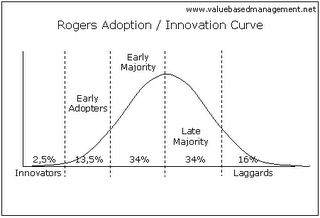
Isn't it funny that this time our students are the early adopters?
I've found a new blog to chew on recently - and I apologize that I can't remember who gave me the lead. Full Circle Online Interaction Blog, "a place to capture and share ideas and links about online interaction, community, distance learning and distributed COPS (Communities of Practice), is a blog by Nancy White who seems to be thinking about the same things I am right now. Her post on Second Wave Adoption has prompted some interesting comments. One in particular has helped me to understand why some educators might be reluctant to adopt blogging as a part of their practice. Michele Martin wrote:
Many organizations still exist within a command and control, closed communication loop. Their institutional practices and relationships to stakeholders are built on this model. But Web 2.0 breaks that wide open, expecting a focus on process, on transparency, collaboration and openness that is simply not a part of the daily culture of many, many organizations.
Well - doesn't that describe traditional education in a nutshell? Don't we always talk about wanting to break down the classroom doors, having teachers become more reflective practioners, utilizing the wisdom of practice that resides within their schoolhouse? Why not use the Web 2.0 tools to start building that professional community? As Kim posted in G-Town:
It’s professional reading, reflecting, and responding. It’s thinking about my audience and what I want to say that potentially can influence thinking or serve a purpose to another educator, student, or parent. It’s about learning. My time spent “blogging”, and by “blogging” I mean reading on-line sources including blogs, writing, and reading comments left on my posts, is all about my own learning. It’s free, it’s accessible 24/7, and it’s what I choose.
Here is the Rogers Innovation Adoption curve that many utilize to determine how they will enact change in their organization:
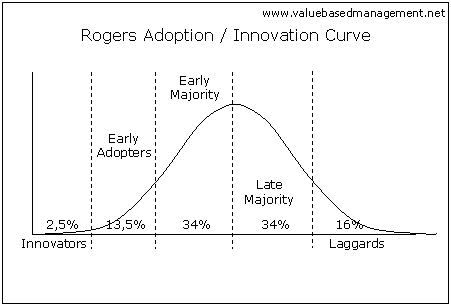
Isn't it funny that this time our students are the early adopters?
Blogs: Phenomena or ???
A person I respect and admire has challenged my thinking about blogs recently. That challenge sat at the back of my mind for a week now and it took an in-service in my district to pop it out to this blog.
I led a group of teachers through the first day of a literacy strand on Thursday. The goal was to create literacy competencies in various subject areas so that we could take a step back from what our students are reading/writing to see the individual components that make up reading/writing and then address those areas that needed support with strategies (that comes with Days 2 and 3). The conversation veered substantially just before lunch………to student motivation.
The conversation bothered me on many levels – but the one that is most relevant here and to the challenge to blogging, is the sense of some educators that students haven’t changed. School isn’t meaningful or engaging to them and that, I think this is what I heard, they are just plain lazy if it doesn’t interest them.
Watch this and tell me students haven’t changed since you were one of them:
(Thank you 21st Century Collaborative!)
Now watch this:
(Thank you Fischbowl!)
I have come to believe that educators (and in fact our entire concept of education) is where the change must happen. Our kids are bombarded by information from lots of sources – we need to teach them to be discriminating consumers of that information. The world has given us MySpace and Instant Messaging – we need to teach students what is appropriate information to put out to the public and the appropriate words to use.
I’m not advocating that students write their essays in IM language – the real world still demands complete sentences (and words!) but we do have a responsibility to recognize that our kids are living in a different world and IM language is a literacy competency they need to have to have power in that world. You don’t need to embrace it – but you do need to acknowledge it.
And so – I think – it is with blogs. Blogs are more than online journals. They can be used in powerful ways by teachers and can engage students in the content we value using a medium they value. So why aren’t more teachers using them? Why aren’t they a part of each and every classroom across this globe?
Lots of reasons, or at least I am told. Here are some I have heard:
1. They are not safe – don’t you watch Dateline?
2. My school blocks all social networking sites.
3. Real life requires pen and pencil, not just a computer. Sure they can type – but they can’t type their state assessment.
4. I don’t have the time to have kids blog when I have content to cover.
5. I don’t have time to learn how to blog so I can teach my students.
6. I don’t blog because I don’t have anything to say – why should I have my kids blog? (Followed by – It’s just an on-line journal!)
7. Blogging doesn’t create real relationships – I want my students to discuss things in class.
8. Blogs are another fad in education– don’t you remember whole language and the damage THAT did?
I have learned so much since being introduced to the Web 2.0 tools this summer. And I have learned it from other educators who have put their experiences out there. As a result, I am bound and determined to make sure blogs aren’t a fad – and I’ve tried with the community of educators that I thought could push the envelope with this blog. So far – it is Blogging 0, Tradition 1. But I’ll continue this investigation and report back here.
In the meantime, I’d love to know…..what’s your excuse?
I led a group of teachers through the first day of a literacy strand on Thursday. The goal was to create literacy competencies in various subject areas so that we could take a step back from what our students are reading/writing to see the individual components that make up reading/writing and then address those areas that needed support with strategies (that comes with Days 2 and 3). The conversation veered substantially just before lunch………to student motivation.
The conversation bothered me on many levels – but the one that is most relevant here and to the challenge to blogging, is the sense of some educators that students haven’t changed. School isn’t meaningful or engaging to them and that, I think this is what I heard, they are just plain lazy if it doesn’t interest them.
Watch this and tell me students haven’t changed since you were one of them:
(Thank you 21st Century Collaborative!)
Now watch this:

(Thank you Fischbowl!)
I have come to believe that educators (and in fact our entire concept of education) is where the change must happen. Our kids are bombarded by information from lots of sources – we need to teach them to be discriminating consumers of that information. The world has given us MySpace and Instant Messaging – we need to teach students what is appropriate information to put out to the public and the appropriate words to use.
I’m not advocating that students write their essays in IM language – the real world still demands complete sentences (and words!) but we do have a responsibility to recognize that our kids are living in a different world and IM language is a literacy competency they need to have to have power in that world. You don’t need to embrace it – but you do need to acknowledge it.
And so – I think – it is with blogs. Blogs are more than online journals. They can be used in powerful ways by teachers and can engage students in the content we value using a medium they value. So why aren’t more teachers using them? Why aren’t they a part of each and every classroom across this globe?
Lots of reasons, or at least I am told. Here are some I have heard:
1. They are not safe – don’t you watch Dateline?
2. My school blocks all social networking sites.
3. Real life requires pen and pencil, not just a computer. Sure they can type – but they can’t type their state assessment.
4. I don’t have the time to have kids blog when I have content to cover.
5. I don’t have time to learn how to blog so I can teach my students.
6. I don’t blog because I don’t have anything to say – why should I have my kids blog? (Followed by – It’s just an on-line journal!)
7. Blogging doesn’t create real relationships – I want my students to discuss things in class.
8. Blogs are another fad in education– don’t you remember whole language and the damage THAT did?
I have learned so much since being introduced to the Web 2.0 tools this summer. And I have learned it from other educators who have put their experiences out there. As a result, I am bound and determined to make sure blogs aren’t a fad – and I’ve tried with the community of educators that I thought could push the envelope with this blog. So far – it is Blogging 0, Tradition 1. But I’ll continue this investigation and report back here.
In the meantime, I’d love to know…..what’s your excuse?
Brain Food!
What I read: Willis, J. (2006)Research-Based Strategies to Ignite Student Learning: Insights from a Neurologist and Classroom Teacher.Alexandria, VA:ASDC.
I’ve read lots and lots of articles and books on how our brain works (or doesn’t!) but this one is different! It is written by a classroom teacher who previously practiced as a neurologist!! This powerful blend of neuroscience and education makes for some great reading – the author has a friendly, engaging manner and you don’t need to have a medical degree to understand the text. The pure science is contained in “Gray Matter” sections that give your brain a break but that you can just as easily skim/skip if you want to get to the classroom applications.
Classroom examples of how to enhance brain-functioning are also including. Nothing too earth shattering here but it does give new meaning to “research based.” For example, in Chapter 1 on Memory, Learning, and Test Taking Success (which can be viewed online) the author talks about the need for the brain to have “syn-naps.” This word play on synapse (the gap between nerve endings) is a brain-friendly way to remind teachers that after repeated release of neurotransmitters from a nerve ending (such as in an intense class involving complex material which might take the form of lecture!) the brain quite frankly needs a rest! These breaks are important for retention of information, but they also help to maintain a positive emotional state (no fidgeting!).
I also enjoyed Chapter 3: How Stress and Emotion Affect Learning, particularly the sub-heading “Where did the joy of learning go?” I have a real connection to that this year as my niece has started first grade and I can already see her love of writing change as she has been gifted with a teacher consumed by the need for perfect hand-writing. (More on that on my writing blog!) This chapter has some great connections to the adolescent learner as well – and would be great to share with middle school teachers!!
The last chapter (there are only four) deals with Assessments That Build Dendrites. Again – the strategies aren’t anything new but the connection to how the brain works is powerful and there is a nice section on my favorite subject – rubrics!!
The book also has a nice glossary in the back if you tend to confuse your amygdala with your hippocampus (I don’t of course – I was just looking for a way to get those words in!)
I would recommend this book for anyone looking to build classroom connections to how the brain works. It is a quick and easy read that helps to make some nice connections (with an online study guide from ASCD available as well!))
Subscribe to:
Posts (Atom)